
Most advice on starting a nutrition coaching business is about finding a niche and choosing a course. The practical setup gets a line at the end, if it’s mentioned at all.
This guide puts the setup in order for coaches in the UK: what you can call yourself, registering with HMRC, the data protection fee, insurance and the advertising rules, then pricing, systems and resources. It ends with a worksheet for your first year’s costs. Short sections cover Ireland and the US.
Fees and thresholds in this guide were checked on official websites on 23 October 2026. This is general information, not legal or tax advice; if your situation is complicated, speak to an accountant.
01 / The short answer
The steps, in order
- Decide what you’ll offer, and to whom.
- Know what you can call yourself, and what’s outside your scope.
- Register with HMRC as a sole trader once you need to.
- Pay the ICO data protection fee and set up how you’ll handle client information.
- Arrange the insurance you need, and any your venues require.
- Check your marketing against the advertising rules.
- Set your prices, forms and onboarding.
- Prepare the resources clients will receive.
- Find your first clients, then plan how you’ll keep them.
02 / Your offer
Decide what you’ll offer, and to whom
Write down who you want to coach and what working with you includes: how long, how often you’ll speak, what the client receives. A clear answer makes every later step easier, from your insurance application to your first social media post.
“Busy parents who want to cook more at home” or “runners training for their first half marathon” gives you something to build around. Our guide to how much to charge for nutrition coaching shows how to turn the service into packages and prices.
03 / Titles and scope
What you can call yourself
Three titles cause most of the confusion:
| Title | Position in the UK |
|---|---|
| Dietitian | Protected by law. Only people registered with the Health and Care Professions Council may use it. |
| Registered Nutritionist (RNutr) | Registration with the Association for Nutrition’s UK Voluntary Register of Nutritionists. Voluntary, and not protected by law at present. |
| Nutritionist, nutrition coach | Not regulated by law. The Association for Nutrition confirms the term “nutritionist” is only voluntarily regulated. |
So you can call yourself a nutrition coach without a particular qualification. What you can do is the more important question. Coaching supports everyday eating and habits; it isn’t treatment. If a client has a medical condition that needs care, such as diabetes, an eating disorder or a condition managed by their GP, work alongside their GP or dietitian or refer them on. Our guide to nutrition coaching forms includes a health screen that helps you spot when to.
04 / HMRC
Register the business with HMRC
Most coaches start as sole traders. You need to register for Self Assessment if you earn more than £1,000 from self-employment in a tax year, which runs from 6 April to 5 April. Tell HMRC by 5 October after the end of the tax year in which you started.
- The £1,000 trading allowance. If your gross income from self-employment is £1,000 or less in a tax year, you don’t need to tell HMRC. Above that, you can deduct the £1,000 allowance instead of your actual business expenses, not as well as them.
- Your business name. A sole trader’s name can’t include “Limited”, “Ltd”, “LLP” or “plc”, can’t be offensive and can’t be too similar to a trademarked name. Some sensitive words, such as “NHS” and “Medical centre”, need permission first. Your own name must appear on official paperwork alongside any business name. The rules are on GOV.UK.
- VAT. You must register for VAT once your taxable turnover over the last 12 months goes above £90,000, or you expect it to in the next 30 days.
Keep a simple record of income and expenses from the first sale. It makes your first tax return, and the cost worksheet below, much easier.
05 / Client information
Data protection and the ICO fee
The Information Commissioner’s Office says organisations, including sole traders, that use personal information need to pay a data protection fee unless they’re exempt. One of the exemptions is not using a computer for it, which rules most coaches back in: client records on a laptop, phone or cloud app count.
The tier 1 fee, for micro-organisations, is £52 a year, or £47 if you pay by direct debit. The ICO notes its small-business guidance is under review, so check the current position when you register.
Paying the fee is only part of it. Answers to a health screen are special category data, with extra rules about consent, storage and deletion. Our forms guide covers what that means for a coach.
06 / Insurance
Insurance: what’s required and what’s sensible
For a sole trader, the insurance the law requires is narrow. You need employers’ liability insurance as soon as you employ someone, with some exceptions such as close family members, and motor insurance for any vehicle you use for the business.
Two other kinds are optional in law but common in practice:
- Public liability: often required by gyms, studios and venues before you can work there.
- Professional indemnity: covers claims that your advice caused a client a loss. Check whether any professional body you join, or venue you work with, requires it.
The government’s insurance guidance sets out when each applies. Get quotes that name nutrition coaching specifically, and check what the policy excludes.
07 / Marketing
What you can claim in your marketing
Your website, social media posts and adverts fall under the CAP Code, which the Advertising Standards Authority enforces. The rules coaches run into most often:
- Evidence: objective claims must be backed by evidence, and where relevant that means trials in people (rule 12.1).
- Medical conditions: don’t discourage essential treatment, or offer specific advice on, diagnosis of or treatment for conditions that need medical supervision unless a suitably qualified health professional supervises it (rule 12.2).
- Food claims: no claims that a food prevents, treats or cures disease, and no health claims that refer to a rate or amount of weight loss (rules 15.6.2 and 15.6.6).
- Weight loss: no claims that people can lose a precise amount of weight in a stated time, and a rate faster than 2 lb (just under 1 kg) a week is unlikely to be acceptable (rules 13.9 and 13.10).
The ASA’s advice on nutritional therapy gives a sense of the line: saying a service could help people who want to manage their weight better is acceptable, but claims to treat or prevent medical conditions need evidence the ASA hasn’t seen. Testimonials and before-and-after photos are marketing too, so check them against the Code before you post them.
08 / Prices and systems
Prices, forms, onboarding and an app
Prices. Work out a minimum price from your income goal, costs and hours, then check it against the market. Our pricing guide walks through the calculation; the costs in the worksheet below are its business costs.
Forms. You need an intake questionnaire, a health screen, a coaching agreement and a weekly check-in from your first client. The forms guide has example questions for each, and what the coaching agreement should cover.
Onboarding. Decide what happens between someone paying and their first review. The onboarding guide gives you the sequence.
An app, or not yet. With a few clients, forms and one organised place for each client’s notes may be enough. If you want an app, some have free plans for small numbers: when we checked on 21 October, Trainerize was free for one client and Everfit for up to five. Our workout-apps comparison covers prices as you grow.
09 / Resources
Client resources: make or buy
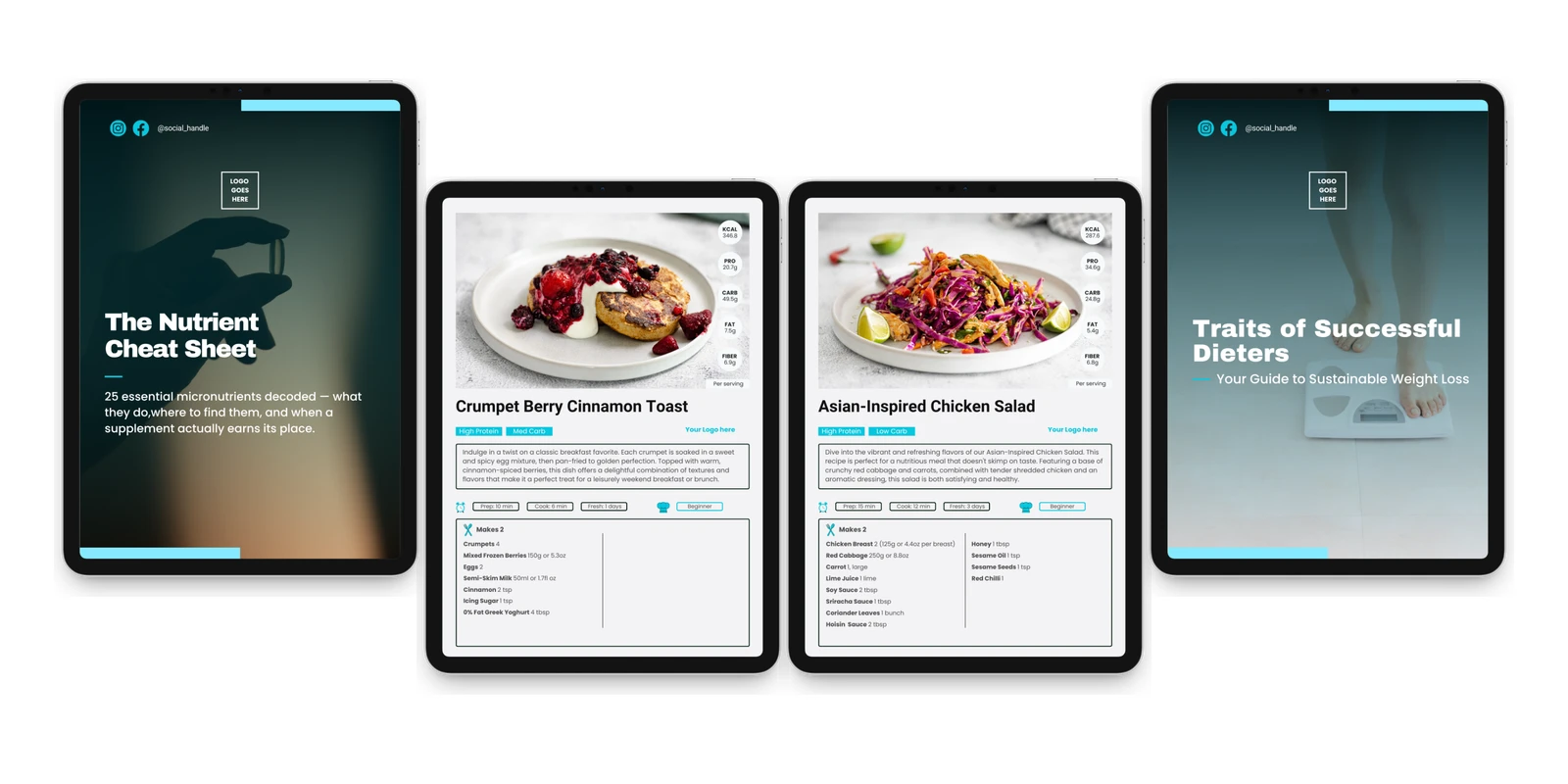
Clients need things to read and use between conversations: a welcome pack on day one, recipes when they ask what to eat, a short guide when the same question comes up twice. You can make these yourself or start from ready-made resources you brand as your own.
- Making your own takes time but fits your approach exactly. Our guides on creating a welcome pack and creating a recipe ebook cover what to include.
- Ready-made, white-label resources save the writing, design and recipe testing, and you add your branding. Our guide to white-label nutrition resources explains how they fit into a service, and what to check in the licence.
Canva’s free plan is enough to brand and export resources as PDFs, according to its plan comparison.
10 / Clients
Your first clients, and keeping them
First clients usually come from people who already know you: friends of friends, people at your gym, followers who have seen you explain things well. A useful free resource gives people a reason to get in touch; our lead-magnet guide shows how to build one around a short guide.
Keeping clients matters as much as finding them, and it’s easier to plan from the start. Our client retention guide covers the points where clients drift away and what to put in place.
11 / Costs
What it costs: a first-year worksheet
“How much does it cost to become a nutrition coach?” mostly depends on the qualification you choose, and prices vary widely between providers. The rest is smaller and easier to pin down. Fill in your own figures:
| Cost | What to know | Your figure |
|---|---|---|
| Qualification | Compare two or three providers, and check what each includes and whether insurers recognise it | |
| ICO data protection fee | £52 a year, or £47 by direct debit (tier 1) | |
| Insurance | Get quotes for public liability and professional indemnity | |
| Coaching app | Free plans for small numbers; paid plans in our apps comparison | |
| Website and domain | A simple site with a booking or contact form | |
| Design | Canva’s free plan exports PDFs | |
| Client resources | Your time to make them, or the cost of ready-made ones | |
| Accountant (optional) | Useful for your first tax return | |
| Total |
The total belongs in the business-costs step of the pricing calculation, so your prices cover it.
12 / Outside the UK
Ireland and the US
Ireland
Self-employed people register for self-assessment with Revenue. You need a PPS number first, then register through eRegistration or Form TR1; once registered, you file returns and pay through ROS. “Dietitian” has been a protected title under CORU since 31 October 2016, and using it without registration is a criminal offence.
United States
The rules vary by state. According to the Bureau of Labor Statistics, many states require dietitians and nutritionists to be licensed, others regulate only certain titles, and a few have no rules for the occupation. Where there are restrictions, they usually cover medical nutrition therapy and titles such as “dietitian” and “nutritionist”, as in North Carolina. Check your state’s board before you start.
13 / Checklist
Setup checklist
| Step | Status |
|---|---|
| Who you coach and what’s includedYour offer | Recommended |
| A title you’re entitled to use“Dietitian” is protected | Required |
| A plan for referring clients with medical needs | Recommended |
| Self Assessment registrationAbove £1,000 a year; tell HMRC by 5 October | Required |
| ICO data protection feeUnless exempt | Required |
| Privacy notice, and a lawful basis for health data | Required |
| Employers’ liability insuranceOnly once you employ someone | Required |
| Public liability and professional indemnity | Recommended; often required by venues |
| Marketing that follows the CAP Code | Required |
| Prices, forms and onboarding | Recommended |
| Client resources ready | Recommended |
14 / Questions
Questions new coaches ask
Do I need a qualification to be a nutrition coach in the UK?
Not by law. “Nutritionist” and “nutrition coach” aren’t regulated, and the Association for Nutrition’s register is voluntary. “Dietitian” is protected. In practice, insurers, gyms and clients may ask what training you have, and a recognised course helps you work safely within your scope.
How much does it cost to become a nutrition coach?
Mostly the cost of your chosen qualification, which varies widely. On top of that come the ICO fee (£52 a year, or £47 by direct debit), insurance, a website and any software or resources you pay for. The worksheet above lists them.
What’s the difference between a nutrition coach, a nutritionist and a dietitian?
A dietitian is registered with the HCPC and can work with medical conditions, including in the NHS. A Registered Nutritionist is on the Association for Nutrition’s voluntary register. “Nutritionist” and “nutrition coach” aren’t protected titles. Coaches typically support everyday eating and habits and refer clients with medical needs.
Do I need insurance?
The law only requires employers’ liability once you employ someone, and motor insurance for business vehicles. Public liability and professional indemnity are optional in law, but many coaches take them out and many venues require them.
The Complete Coach Toolkit
Start with the library
already built.
31 recipe books and 32 educational guides to brand in Canva, plus 70 Instagram templates, a Notion CRM for client records and check-ins, and the Social Selling Playbook. The resources a new coaching business would otherwise build in its first year, ready for your logo.
Explore the Complete Coach Toolkit