
A price works when it covers the hours each client takes and still leaves you the income you need.
Published rates can tell you whether your number is unusual. They can’t tell you whether it pays. This guide starts with what surveys say coaches charge, then works through a calculation you can repeat with your own figures. The example uses US dollars; the steps are the same in pounds, euros or any other currency.
01 / The short answer
How much do nutrition coaches charge?
There’s no standard rate. In the United States, ConsumerAffairs found most online nutrition coaching services cost $99 to $200 a month, and Precision Nutrition’s survey of more than 1,000 coaches put the median at $65 an hour.
Your own price comes down to two things you can work out: how many hours each client takes, and how much the business needs to bring in. The rest of this guide takes each in turn.
02 / Benchmarks
What published figures show
| Source | Figures |
|---|---|
| Precision NutritionA survey of more than 1,000 nutrition coaches, with rates in US dollars | Median $65 an hour. Online $64.50, in person $65, hybrid $75. The top 10% charged more than $120. |
| ConsumerAffairsThe listed prices of 21 in-person and online services in the US, updated November 2024 | Online: $99 to $200 a month. In person: $100 to $250 for a first consultation, $75 to $165 for a follow-up. |
Both sources are American, and neither is recent. Precision Nutrition’s report isn’t dated and doesn’t say where its respondents worked; it appears to have been published in 2019. ConsumerAffairs looked at services, many of them companies, rather than at independent coaches.
What a price buys matters as much as the number. The cheapest services ConsumerAffairs found, at $65 to $99 a month, covered little more than a first consultation and one follow-up a month. The dearer ones added weekly check-ins, unlimited messaging and personalised meal planning.
We couldn’t find an independent survey of prices in the UK or Ireland. If you coach there, build your own sample: note what ten coaches serving a similar client in your market charge, and what each includes. Count the calls, how often check-ins happen and whether messaging is part of the price.
03 / Your time
Count the hours each client takes
Calls are the visible part of coaching. Reading check-ins, answering messages, preparing for calls and finding the right resource take time too, and none of it shows up in your calendar. List everything one client on a given package takes in a typical month.
| Task | Time a month |
|---|---|
| Two 30-minute video calls | 1 hour |
| About four weekly check-ins, 20 minutes each to read and reply | 1 hour 20 minutes |
| Messages between check-ins | 1 hour |
| Preparing for calls, updating notes and choosing resources | 40 minutes |
| Total | 4 hours |
If you already have clients, time a few of them for a month instead of estimating. Include the short replies; they add up.
04 / The calculation
Work out your minimum price
The example follows a fictional online coach. Replace each figure with your own.
| Step | Example |
|---|---|
| 1. Income you want each year, before tax | $48,000 |
| 2. Business costs each year: software, insurance, training and resources | $4,800 |
| 3. Revenue needed | $52,800 a year, or $4,400 a month |
| 4. Hours you’ll work | 30 a week for 46 weeks: 1,380 a year, about 115 a month |
| 5. Hours left for client work after marketing, sales calls, admin and training | 60%: 69 a month |
| 6. Hours each client takes | 4 a month |
| 7. Clients at full capacity | 69 ÷ 4 = 17 |
| 8. Clients to plan on | 14, a little over 80% of capacity |
| 9. Minimum monthly price | $4,400 ÷ 14 = $314.29, so $315 |
Step 4 leaves six weeks for holidays, public holidays and illness. The 60% in step 5 is an assumption; once you’ve tracked a month of your own work, use the real share. Step 8 allows for clients starting and finishing at different times, which means you’ll rarely be full all year.
At $315 for four hours, each hour spent on a client earns $78.75. Across every hour worked, including marketing and admin, the business brings in about $38 ($52,800 ÷ 1,380). The difference pays for the work that doesn’t belong to any one client.
The income in step 1 is before tax. Set money aside according to the rules where you work.
05 / The market
Check your number against the market
Put your minimum beside the published figures. The example’s $78.75 for each hour of client work is above Precision Nutrition’s $65 median, and $315 a month is above the $99 to $200 that ConsumerAffairs found online. The comparison is rough: the survey asked about hourly rates, while this example counts every minute spent on a client, not only time in sessions. Even so, it tells this coach that the package sits at the fuller end of the market, so what it includes has to be easy to see.
If your minimum is well above what comparable coaches charge, look at the inputs first. You might be planning more client time than the package needs, or expecting the business to reach your full income in its first year. You can also change what the package includes. Fewer calls, fortnightly check-ins or set times for replying to messages all reduce the hours in step 6.
If your minimum is well below the market, the package may be underpriced, or your hours may be missing something.
Where you sit in the range depends on more than the calculation. ConsumerAffairs found that prices rose with the services included and with the coach’s experience and training. In Precision Nutrition’s survey, coaches with a nutrition degree, two or more certifications, or Precision Nutrition’s own certification charged about $12 an hour more than coaches with a single certification. The report notes that correlation doesn’t prove one causes the other.
06 / Packages
Turn the price into packages
Once you know what an hour of client work needs to earn, the same figure prices every version of your service. Count the hours, then multiply.
| Package | Price a month |
|---|---|
| Light: 2 hoursTwo written check-ins, weekday messages and chosen resources | $157.50, so $160 |
| Standard: 4 hoursWeekly check-ins, two calls, weekday messages and chosen resources | $315 |
| Intensive: 6 hoursWeekly check-ins, weekly calls, weekday messages and chosen resources | $472.50, so $475 |
A lighter package needs more clients to fill the same hours, and each new client brings its own onboarding and marketing time.
Fixed-length programmes
If you sell programmes of a set length, price them from weekly figures. Twelve weeks is 84 days, about 2.8 months rather than three. At $315 a month, the weekly equivalent is about $73 ($315 × 12 ÷ 52 = $72.69), so twelve weeks comes to about $872.
Programmes usually front-load work, such as a longer first consultation and setting up the client’s resources. Add that time too: two extra hours at $78.75 would bring this one to about $1,030.
Discounts for longer commitments
ConsumerAffairs found that almost all the monthly services it reviewed offered discounts for committing to three, six or twelve months. If you offer one, check that the discounted price still clears your minimum.
Name what each package includes
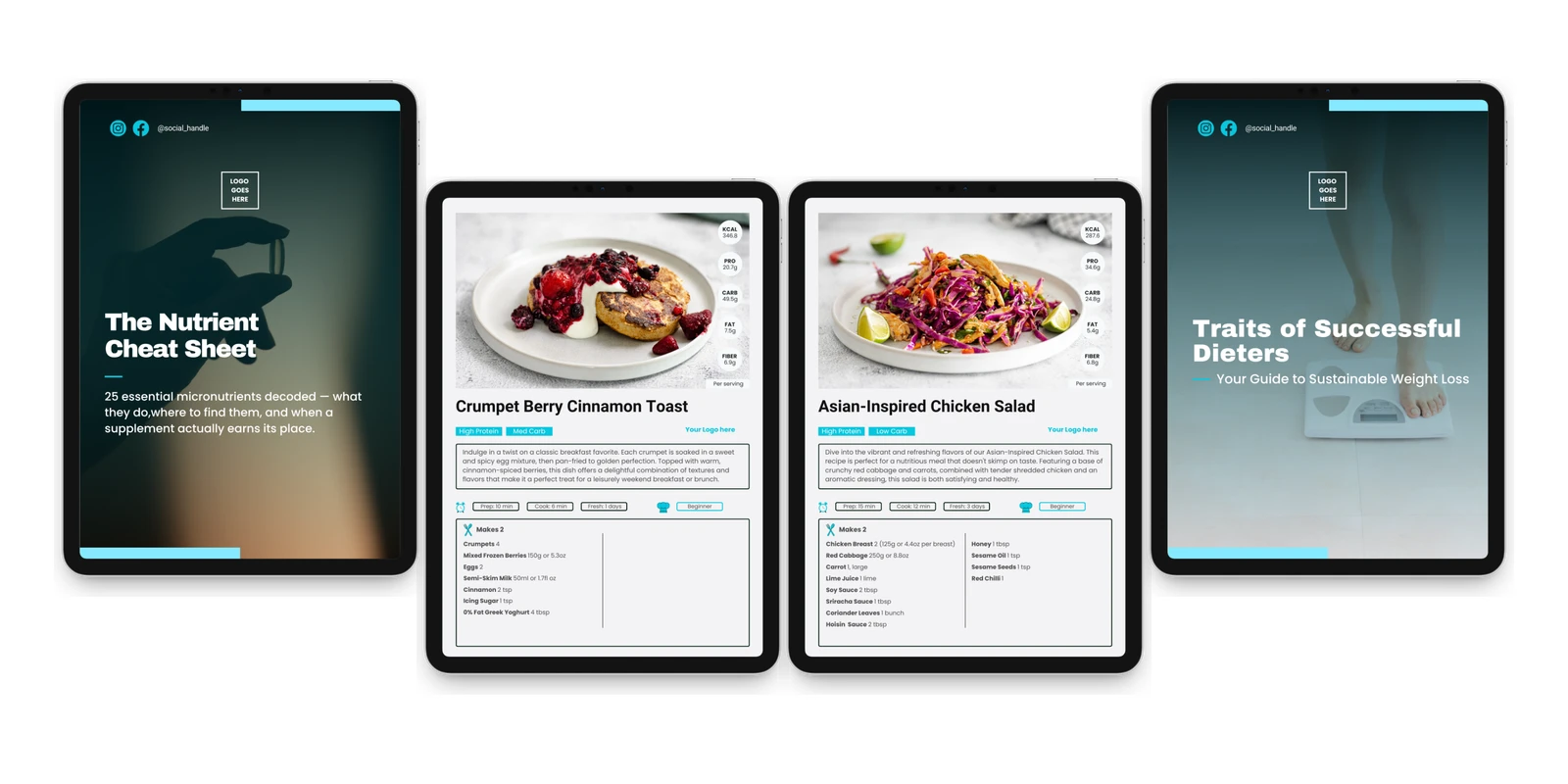
“Weekly check-in, with a written reply within two working days” tells a client more than “ongoing support”. If resources are part of the package, such as a branded recipe book or a set of educational guides, list them by name. Our guide to white-label nutrition resources explains how ready-made materials can fit into a coaching service.
07 / The conversation
Present the price clearly
Write the price down with what it includes, whether on your website, in a proposal or in the message after a sales call. A client comparing coaches can then see what the money buys.
State it plainly. “I know it’s a lot, but…” invites the client to treat the price as open to negotiation.
Put the terms in your coaching agreement: when payment is due, how renewals work, how to cancel and how refunds are handled. Our guide to nutrition coaching forms covers what the agreement usually includes. Once someone has paid, the client onboarding guide takes it from signup to the first review.
08 / Every year
Review your prices
Run the calculation again at least once a year, and whenever your costs or the hours a package takes change. Precision Nutrition suggests raising prices by about 3% a year to keep pace with inflation, and giving existing clients four to six weeks’ notice of an increase.
Tell existing clients in writing, with the date the new price starts and anything that changes in the service. Check your agreement first: if it fixes the price for a set term, the increase waits until renewal. New clients can pay the new price from your next enquiry.
09 / Questions
Questions coaches ask
Should I charge by the hour or by the package?
Online nutrition coaching is usually sold by the month: every online service ConsumerAffairs reviewed required a monthly commitment. An hourly or per-session fee suits one-off consultations. Whichever you use, know what an hour of client work needs to earn, because that’s what tells you whether a package pays.
Should I put my prices on my website?
Coaches do both. Published prices let people rule themselves in or out before booking a call. Keeping prices for the call lets you recommend a package first. Either way, give the price in writing before anyone pays.
Do my prices need to include VAT or sales tax?
That depends on where you work and whether you’re registered. If you charge VAT or sales tax, say whether the prices you show include it. In the UK, GOV.UK explains when you must register for VAT. This is general information, not tax advice, so check with an accountant if you’re unsure.
The Complete Coach Toolkit
Name what each package
includes.
31 recipe books, 32 educational guides and 70 Instagram templates to brand in Canva, with a Notion CRM for client check-ins and the Social Selling Playbook. Build the resources into the packages you sell, and keep each client’s check-ins and next actions in one place.
Explore the Complete Coach Toolkit