
A good consultation form does two jobs. It gives you what you need to train someone safely, and it shows a new client you’ve thought about them before they arrive.
Below is a free consultation and intake form for personal trainers, as a printable PDF and an editable Word file. The rest of this guide explains what each section is for, how to handle health screening, and how to run the consultation around it. Nutrition coaches have their own version in our guide to nutrition coaching forms.
01 / Download
A free personal training consultation form
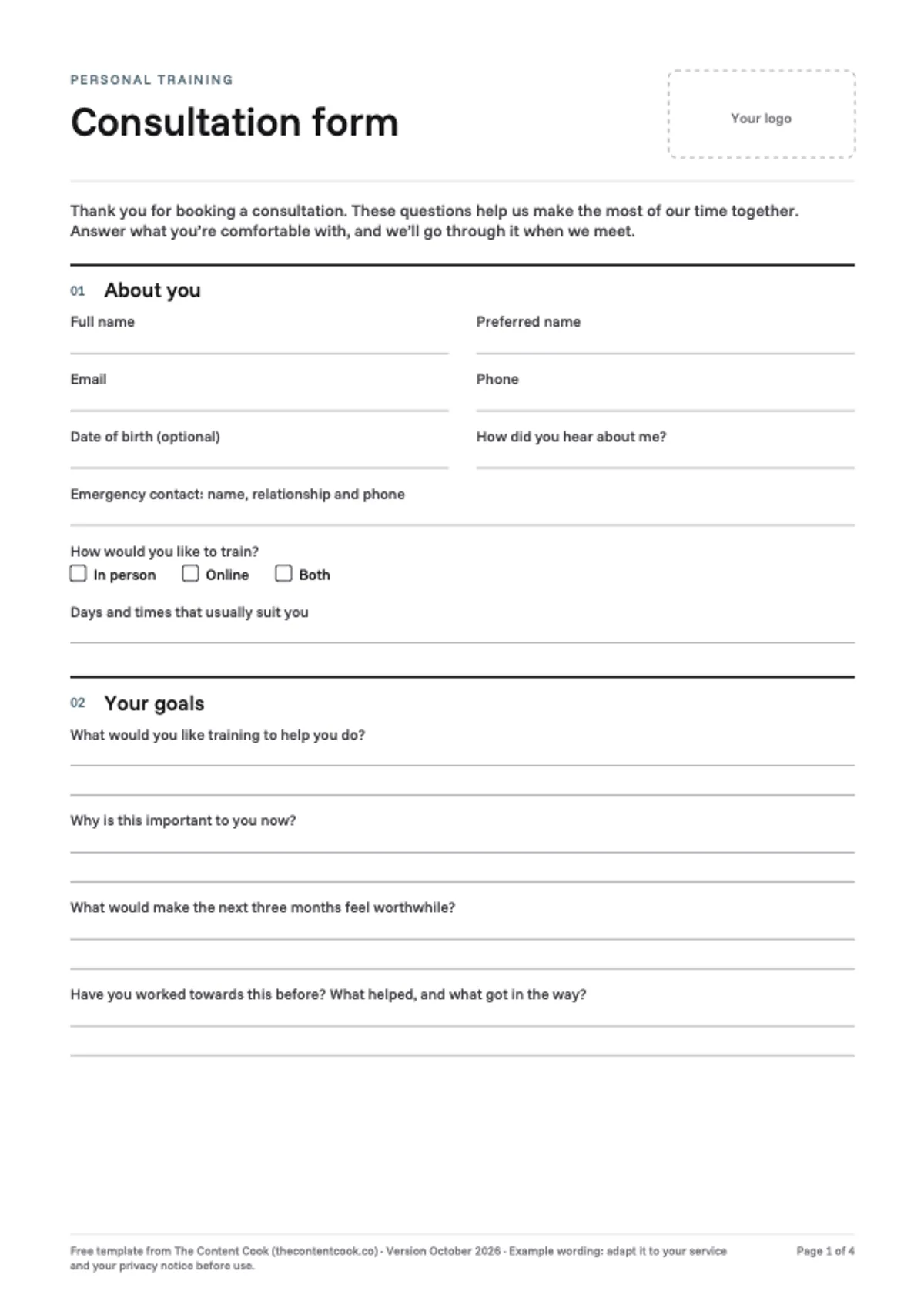
Consultation and intake form
Four A4 pages: client details, goals, activity and training, health and readiness, lifestyle, a starting-point record for you, consent, and the agreed next step. There’s space for your logo, and no sign-up is needed.
Use the Word file to add your logo and change the wording; it also opens in Google Docs. Free to use and adapt for your own clients. Please don’t resell it or offer it as your own template.
02 / Beforehand
Before the consultation
- Send it a day or two ahead. It gives the client time to think about their answers, and you time to read them.
- Keep it easy to complete. Most people will fill it in on a phone. If you send it as a PDF, offer to go through any part they’d rather discuss.
- Read it before you meet. Note anything to ask about, especially health answers marked “yes” or “not sure”.
If the consultation follows an enquiry, our guide to getting personal training clients covers the steps that lead up to it.
03 / The questions
What to ask, section by section
Every question should earn its place. If you can’t say what you’ll do with an answer, leave it out.
1. About you
Contact details, an emergency contact, how they found you, and when and how they’d like to train.
Why: you need to reach them, and someone else in an emergency. “How did you hear about me?” tells you which routes bring clients. Date of birth is optional: ask only if you’ll use it.
2. Your goals
What they want training to help with, why now, what the next three months would need to include to feel worthwhile, and what has helped or got in the way before.
Why: their own words give you the goal, the motivation behind it and the obstacles to plan for. “Why now?” often tells you more than the goal itself.
3. Activity and training
Current activity, previous training and sports, what they enjoy or avoid, and the equipment they can use.
Why: it sets your starting point and shows what they’re likely to keep doing. A plan built around activities they enjoy is easier to stick to.
4. Health and readiness
Diagnosed conditions, medication, pregnancy or a recent birth, injuries, pain or recent surgery, current care from a health professional, and any advice to limit exercise, each with “yes”, “no” or “not sure”.
Why: to spot anything that means adapting the plan, getting clearance first or referring on. Section 4 of this guide covers what to do with the answers.
5. Lifestyle
Sleep, stress, working pattern, eating habits in brief, and anything likely to make the next few months harder.
Why: these shape how much training someone can recover from and fit in. Keep nutrition questions general: detailed dietary advice for a medical condition belongs with a GP or dietitian.
6. Starting point
A page for you to complete with the client: the measures you’ve agreed to track and their starting values. Section 6 below covers choosing them.
7. Information and consent
How you’ll use, store and delete their answers, a separate consent box for health information, and optional, separate boxes for progress photos and for using photos in your marketing.
Why: health answers carry extra protection under data protection law, and photo consent for marketing has its own rules. Our getting-clients guide covers testimonials and before-and-after photos.
8. Agreed next step
The package, price, first session and first review date, filled in at the end of the consultation.
04 / Screening
Health screening and the PAR-Q+
The PAR-Q+ is a widely used pre-participation screening questionnaire, published by the PAR-Q+ Collaboration at eparmedx.com. Its terms say official, unmodified versions are currently available without charge for eligible uses, subject to its conditions, and that changing it or building it into other forms or products needs written permission. That’s why our form doesn’t copy it: if you use the PAR-Q+, give clients the official version alongside your form, and check its terms cover the way you’ll use it.
Whichever screening you use, decide in advance what each answer means for you:
| Outcome | When it might apply |
|---|---|
| Go ahead | No answers that change the plan |
| Adapt the plan | Something to work around, such as an old injury, that doesn’t need medical input |
| Clearance first | An answer the screening tool, your training or your insurer says needs medical advice before starting |
| Refer on | Something outside your scope, such as a condition that needs specialist care |
Writing this down before anyone fills in the form keeps your responses consistent. The form has a box for you to record the outcome and next step.
05 / The conversation
Running the consultation
The form gives you the facts; the conversation is where you work out whether you can help and how. A simple structure:
| Part | What happens |
|---|---|
| Welcome | Thank them, explain how the session will run |
| Goals | Ask them to describe what they want in their own words, and why now |
| The form | Go through anything you flagged, especially health answers |
| Movement check | In person, a few simple movements to see how they move; online, ask them to film one or two |
| First step | Agree one practical thing to start with |
| Your offer | Explain what working together includes and the price, then let them decide |
Refer to what they told you, make one clear recommendation, give the price plainly and leave room for them to decide. Once they say yes, the onboarding guide covers what comes next.
06 / Starting point
Recording a starting point
Agree with the client which measures matter to them, and record only those. A few chosen measures are easier to repeat consistently than a long battery of tests, and they mean more to the client.
- Choose together. Some clients find weighing useful; for others it gets in the way. Strength, how they move, energy and sleep can all show progress.
- Record how you measured. Time of day, equipment and method, so the next measurement is comparable.
- Set a review date. Our client retention guide covers using reviews to show progress.
07 / Online
Consultations with online clients
The same questions work online. Send the Word version, or rebuild the questions as an online form in a tool such as Google Forms or Microsoft Forms. Some coaching apps include forms; in our workout-apps comparison, Trainerize lists custom consultation forms on its Pro plan. Run the consultation by video, and ask the client to film one or two simple movements rather than attempting a full assessment remotely.
08 / Storage
Storing the answers
Health answers are special category data, which carries extra rules about consent, access and how long you keep it. Our forms guide covers what that means for a coach, and the start-a-business guide covers the ICO data protection fee.
In practice: keep each client’s form in one place with their record, limit who can see it, and delete it on the schedule you’ve told them. A paper form you’ve photographed and also kept in a drawer is two copies to manage.
09 / Questions
Questions trainers ask
Is a PAR-Q enough on its own?
It’s a screening questionnaire: it helps identify who should get medical advice before becoming more active. It doesn’t tell you someone’s goals, history or preferences, which is what the rest of a consultation form is for.
Do I need clients to sign a waiver?
A signed form can record that a client understood what training involves, but it doesn’t remove your responsibility to train them safely. Under the Consumer Rights Act 2015, a business can’t exclude or restrict liability for death or personal injury caused by negligence through a term of a consumer contract or a consumer notice. Screening, sensible programming and insurance protect you more than a signature. Take advice if you want a written agreement.
How often should I update a client’s form?
Ask clients to tell you about health changes as they happen, and review the form at least when you review their programme, or after a long break.
Can I use it with online clients?
Yes. Send the Word file or turn the questions into an online form, and run the consultation by video.
The Notion CRM
Keep every client’s answers
in one place.
A Notion workspace with a client database, a page template for each client, a weekly check-in database and a progress tracker, so consultation notes, check-ins and next actions sit together. Works with Notion Free.
Explore the Notion CRM