
If you’ve been writing fully custom meal plans for every client, this post is going to be uncomfortable — in a useful way.
Custom meal plans are one of the most persistent features of nutrition coaching. They feel premium. They feel personal. They feel like the thing clients are paying for. And yet, for the overwhelming majority of nutrition coaches, custom meal plans are the single biggest silent drain on their effective hourly rate — and one of the primary reasons coaches burn out, plateau, or stop enjoying the work they trained years to do.
This guide is not an argument against personalisation. Personalisation absolutely matters. The argument is narrower and more specific: writing a brand-new, fully bespoke meal plan from scratch for every client is almost never the best way to deliver it.
Here’s the maths behind that claim, why most coaches keep doing it anyway, when custom plans genuinely make sense, and the practical workflow that replaces them without losing a single thing your clients actually care about.
Let's do the maths first
Consider a nutrition coach charging $300 a month for a three-month programme. That’s $900 in revenue per client. Respectable on paper. Now assign honest time estimates to what that client actually costs in hours:
| Time spent per client, per month | Hours | At $50/hr |
|---|---|---|
| Writing a fully custom meal plan | 4 hrs | $200 |
| Adjusting and re-sending the plan | 1.5 hrs | $75 |
| Coaching calls and check-ins | 2 hrs | $100 |
| Admin, messaging, onboarding | 1.5 hrs | $75 |
| Total per client, per month | 9 hrs | $450 value |
At nine hours a month per client, that $300 payment works out to around $33 per hour of actual effort. Not terrible. But remember that figure includes the coaching calls — the work you trained for and want to be doing. Strip out the four hours on custom plan writing alone, and you’ve just reclaimed around $200 of monthly opportunity cost per client.
Now scale that across ten clients. That’s 40 hours a month, or roughly a full working week, that you are spending building custom meal plans rather than coaching, growing your business, or genuinely personalising the elements of your service that drive results.
This is not a rare calculation. This is the typical coach’s month. And it is the single clearest reason why coaches who are technically excellent at their craft end up earning less than coaches who are merely competent but better at systematising delivery.
The coaches with the highest effective hourly rates are almost never the ones writing the most custom content. They are the ones who have built a delivery system that produces personalised-feeling experiences without bespoke effort at every step
Why coaches keep writing custom plans anyway
If the maths is this clear, why does the practice persist? The reasons are rarely logistical. They are almost always psychological, and naming them is the first step to changing the behaviour.
1. The guilt reflex
Many coaches feel that anything less than a fully custom plan is somehow cutting corners. Using a templated plan, even one you adapt thoughtfully, can feel like delivering less than the client deserves. This is almost entirely a coach problem, not a client problem. Clients cannot tell the difference between a plan written from scratch and one adapted from a well-designed template — as long as it reflects their goals, preferences, and circumstances.
2. The differentiation myth
There’s a belief that custom plans are what separates a qualified nutrition coach from a fitness app or a generic online programme. In fairness, personalisation does separate you — but the personalisation clients notice and value is in the coaching relationship, the check-ins, the behavioural work, and the way you translate nutrition science into their real life. Not in whether the spreadsheet was built today or last month.
3. The pricing anchor
Custom plans often get used as a pricing justification — the reason a coach can charge $300 a month rather than $100. Remove the custom plan, the logic goes, and what are you charging for? This is solvable, but it requires repositioning your offer around outcomes and ongoing support rather than the deliverable of a brand-new PDF each month.
4. The early-career habit that never got updated
Most coaches start out with one or two clients, plenty of time, and genuine enthusiasm for building something tailored from scratch. That’s appropriate for that stage. The problem is that the habit survives the transition from two clients to twenty — and by the time the workload becomes unsustainable, the practice feels too integral to change.
When custom meal plans genuinely make sense
There is a specific subset of clients where writing a fully bespoke plan is genuinely the right call, and it’s worth being clear about who they are. If you coach any of the following, custom plans remain justified — and in some cases clinically necessary:
- Clients with complex clinical conditions — multiple food allergies, medically managed eating disorders, or diagnoses like coeliac disease or IBS where individual dietary mapping is therapeutic
- High-level athletes with precise periodisation needs around competition, training blocks, or weight categories
- Clients with unusual dietary patterns — severely restrictive religious or ethical frameworks combined with specific health goals — where no template will reasonably adapt
- Premium one-to-one packages where a fully bespoke plan is a stated, priced deliverable that the client has specifically purchased
For the rest — which in practice is the large majority of general nutrition coaching clients working on fat loss, muscle gain, energy, performance, or building sustainable habits — a templated approach that is thoughtfully personalised gives clients the same outcome, often better, in a fraction of the time.
A custom plan matters for the 10–20% of clients whose situation genuinely demands it. For everyone else, the custom plan is a deliverable that satisfies the coach’s sense of thoroughness more than the client’s need for results.
Custom vs templated + personalised — the honest comparison
The alternative to writing every plan from scratch is not “sending a generic plan and hoping.” It’s a structured, professional system where you draw from a library of well-built templates and adapt them to each client through layered personalisation. Here’s how the two approaches compare across the variables that actually matter:
| Variable | Custom plan | Templated + personalised |
|---|---|---|
| Time per client | 4–6 hrs | 30–45 mins |
| Consistency of quality | Variable | High — always |
| Ease of updating | Start again | Swap or layer |
| Scalability | Hits a ceiling fast | Scales cleanly |
| Client perception | Perceived as premium | Equal or higher when done well |
The critical row in that table is the last one. Clients do not perceive a well-adapted templated plan as “lower quality” than a from-scratch one. In most cases, they perceive it as higher quality, because the template has been professionally designed, is consistent across clients, and is backed by polished materials. What they’re judging is not the origin of the document — they are judging whether it reflects them.
The replacement workflow — step by step
Here’s how to deliver a fully personalised meal plan experience without writing a fresh plan for every client. This is the workflow that the most profitable nutrition coaches use, and once it’s in place it tends to free up between six and ten hours a week.
Step 1 — Build or source a core library
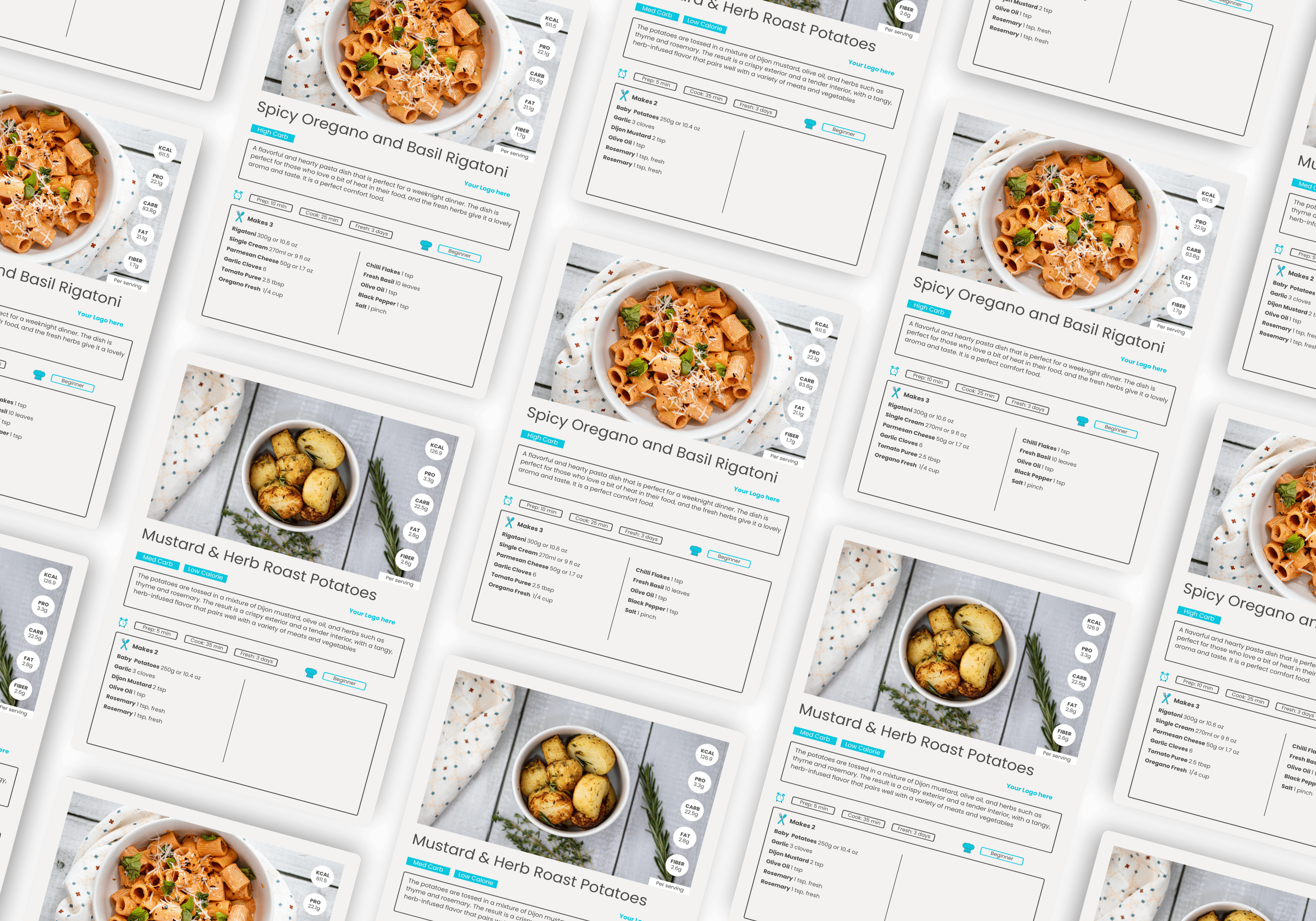
Start with a small, well-organised library of templated plans. Three to six core templates will cover the vast majority of general coaching clients: a higher-protein fat loss structure, a performance-focused training day plan, a rest-day maintenance plan, a plant-based version of each. You can build these yourself (once — as a capital investment in your business) or source them as white-label resources from a nutritionist-developed provider. Either way, they need to be professionally designed and evidence-based from day one.
Step 2 — Capture real personalisation data at intake
A templated plan only works if you personalise what actually matters. At intake, focus on the data that genuinely changes the recommendation: calorie and macro targets, food preferences and aversions, any allergies or intolerances, typical weekly schedule, number of meals per day, cultural or religious dietary patterns, cooking skill and time availability. Most coaches over-collect at intake and under-use what they collect. Flip that.
Step 3 — Select and adapt the right template
This is where the hour-saving happens. Instead of a blank page, you start with a structurally sound plan and layer in the personalisation. Swap proteins to match preferences. Adjust portion sizes to hit the client’s specific macro targets. Remove or substitute any allergens or disliked foods. Add a note or two that reflects something personal from the intake call. This typically takes 30–45 minutes per plan versus the four hours of from-scratch writing.
Step 4 — Deliver it inside a branded, professional experience
How the plan is delivered matters more than most coaches realise. Send it as part of a branded welcome pack — your logo, your colours, a personal intro note — and the perceived value goes up regardless of whether the underlying plan took three hours or thirty minutes to build. This is where investment in white-label Canva templates pays off almost immediately: you are no longer delivering a Google Doc, you are delivering what looks and feels like a professional product.
Step 5 — Build adjustment into the check-in system
Most of the “custom” work in nutrition coaching doesn’t actually happen at the plan-building stage. It happens in response to check-in data — adjusting calories based on progress, swapping meals that aren’t working, adding options for travel weeks, simplifying a plan that’s become too rigid. Make that ongoing adjustment your differentiator rather than the initial plan itself. It’s where the real coaching value lives.
What to say when a client asks "is this custom?"
This is the objection coaches are most afraid of, and in practice it almost never comes up when the service is designed well. But it’s worth having an answer ready — one that is honest, confident, and correctly positions what you do.
A version that works: “Your plan is personalised to your goals, preferences, schedule, and any food considerations you told me about at intake. I use a core framework as a starting point — the same way a qualified strength coach uses programming structures that work — and I adapt it to you. That lets me spend the time on what actually changes your results: the ongoing coaching, the adjustments, and the accountability.”
Notice what that does. It acknowledges the framework honestly. It reframes the framework as a feature, not a shortcut. And it redirects the client’s attention from the document to the relationship — which is where the real value has always lived anyway.
Clients don’t buy documents. They buy outcomes, support, and a sense of being looked after. Whether the plan was written this morning or adapted from a template is entirely irrelevant to all three.
The quiet cost you haven't calculated yet
There’s a cost to writing custom plans that doesn’t show up in any hourly rate calculation: the opportunity cost on your business itself.
Every hour you spend in the weeds of individual plan construction is an hour you are not spending on the things that grow a coaching business — content creation, community building, refining your offer, studying to deepen your expertise, or simply resting enough to show up well for the clients you already have. Coaches who can’t get out of the delivery trap tend to plateau at a specific client ceiling — usually somewhere between eight and fifteen clients — and stay there for years, convinced they’ve hit a capacity wall.
The wall isn’t capacity. It’s the workflow.
Move to a templated + personalised delivery model and the ceiling moves too. Thirty clients becomes realistic without burning out. Forty becomes possible. More importantly, the time you reclaim gets reinvested into things that compound — content, referrals, positioning — rather than things that reset to zero at the start of every new intake.
Frequently asked questions
Not reliably. Premium pricing is justified by outcomes, the quality of the coaching relationship, and the perceived professionalism of the overall client experience. A coach who uses templated plans inside a polished, branded delivery system will consistently out-charge a coach handing over custom plans in unbranded Google Docs. What justifies premium pricing is the totality of the service, not the origin of the document.
Almost never — and more importantly, it doesn’t matter if they do. Clients care whether the plan reflects them: their goals, their food preferences, their schedule, their calorie and macro targets. A well-adapted template that reflects all of those is functionally identical to a from-scratch plan from the client’s perspective. The only risk is when coaches skip the personalisation layer and send a visibly generic plan — that’s a workflow failure, not a template failure.
No. What makes you a qualified nutritionist is your education, your professional registration, your clinical reasoning, and your ongoing application of evidence-based practice. Writing plans from scratch is a workflow choice, not a credential. Registered dietitians and sports nutritionists at the top of the profession routinely use templated frameworks — because they’ve recognised that their expertise adds more value in the decisions about what the client needs, not in the manual construction of every document.
You don’t need to announce the change. The switch is a backend workflow change, not a product change. The client still receives a personalised plan that reflects their goals and preferences — it just takes you less time to produce. If existing clients have explicitly been sold “fully custom plans every month” as a named deliverable, honour that for the remainder of their current contract and adjust your packaging going forward.
These are exactly the situations where a well-built template library pays off. A good library includes plant-based, gluten-free, dairy-free, and allergen-tagged variants — so personalising for a client with a specific need becomes a selection and substitution exercise rather than a from-scratch build. For the rare client with complex overlapping clinical needs, a fully custom plan remains appropriate. For the majority, a properly tagged template system handles it faster and more reliably than manual construction.
Ready to reclaim the hours?
The Complete Coach Toolkit gives you a full library of white-label, nutritionist-developed meal plans, recipe books, and client education resources — professionally designed, evidence-based, and ready to brand as your own. It’s the foundation of the templated + personalised delivery system described in this post, built specifically for nutrition coaches who want to stop spending evenings writing plans from scratch.